


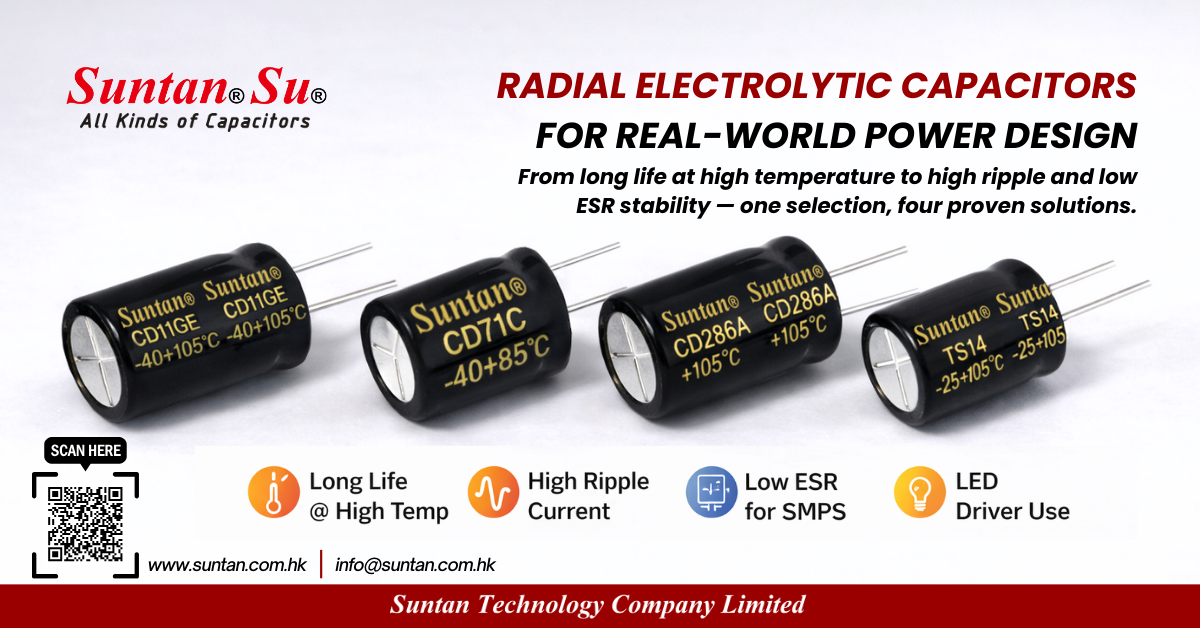
Thermal and Ripple Stress Impact in Power Supply & LED Driver Designs
High PCB temperatures and ripple current stress significantly reduce radial electrolytic capacitor lifetime in power supply and LED driver designs. In real circuits, capacitors operate under thermal conditions far harsher than ambient specifications, making temperature rise and ripple current the dominant lifetime factors.
Reference category: Radial Aluminum Electrolytic Capacitors
1. Real PCB Conditions: Temperature and Ripple Stress
In practical layouts, radial electrolytic capacitors are often positioned near MOSFETs, transformers, diodes, and regulators. These heat sources elevate local PCB temperature. Simultaneously, output filtering in SMPS and LED drivers produces continuous AC ripple current. The combined thermal and electrical stress means radial electrolytic capacitor lifetime is governed by internal core temperature rather than ambient air temperature.
2. Internal Heating Mechanism
P = I² × ESR
Ripple current flowing through equivalent series resistance generates heat inside the electrolyte and foil structure. As internal temperature rises, electrolyte evaporation accelerates, increasing ESR and further raising heat generation. This positive feedback loop shortens service life and explains ripple current capacitor stress effects.
3. Lifetime Reduction and Wear-Out Behavior
Electrolytic capacitor lifetime approximately follows a temperature acceleration model where life halves for every 10°C rise in core temperature. Ripple heating adds to ambient conditions, pushing components toward endurance limits.
Wear-out symptoms include capacitance reduction, ESR increase, output ripple growth, LED flicker over time, and SMPS loop instability. These behaviors originate from electrolyte dry-out rather than dielectric breakdown.This aging mechanism is typical of high temperature capacitor operation in power electronics environments.
4. Lifetime Impact Across Power Electronics Applications
Radial electrolytic capacitor lifetime varies significantly depending on how thermal and ripple stress combine in different power architectures. The same endurance rating can translate into very different field lifetimes under distinct load profiles.
LED Drivers: Enclosed luminaires often operate at elevated ambient temperatures with limited airflow. Output capacitors experience both high core temperature and moderate ripple stress for extended continuous hours. The dominant aging driver is sustained thermal load, making high temperature capacitor grade selection critical.
SMPS Outputs: Switch-mode power supplies impose high ripple current capacitor stress at switching frequency and harmonics. Even when ambient temperature is moderate, I²R heating raises internal core temperature. Lifetime reduction is primarily ripple-driven rather than environment-driven.
Industrial Power Supplies: Long duty cycles combined with variable load conditions create alternating thermal and ripple stress. These systems often run continuously, so endurance hours and ripple rating must be evaluated together to prevent gradual ESR growth and output instability over time.
5. Engineering Decision Framework
Selection should be based on PCB hotspot temperature, ripple RMS current, endurance hours (2000h / 5000h / 10000h), airflow conditions, and enclosure thermal behavior. Comparing ripple rating, temperature class, and endurance hours together ensures proper lifetime margin.
Typical Lifetime Impact Comparison Under Different Stress Conditions
| Application | Ambient Temperature | Ripple Current Stress | Dominant Aging Driver | Lifetime Risk Level | Selection Focus |
|---|---|---|---|---|---|
| LED Drivers | High | Medium | Thermal Stress | High | High temperature grade, long endurance hours |
| SMPS Outputs | Medium | High | Ripple Heating | High | High ripple rating, low ESR series |
| Industrial PSU | Medium to High | Medium to High | Combined Thermal & Ripple | Very High | Ripple + endurance hours balanced |
| Consumer Electronics | Low to Medium | Low to Medium | Moderate Stress | Medium | Standard endurance series |
Video Reference
Engineering Reliability Background
The lifetime reduction mechanisms discussed above are typical of aluminum electrolytic capacitors operating under elevated core temperature and ripple current stress. Service life is primarily limited by electrolyte depletion and the resulting ESR increase, both of which accelerate as internal temperature rises.
These temperature-driven aging behaviors are widely recognized in electronic reliability engineering practice, where thermal stress is treated as a key factor influencing component wear-out over time. Additional background on temperature-related aging in electronic assemblies can be found in engineering reliability literature.
Provide PCB temperature, ripple current, and expected lifetime requirements for specification matching.