



Voltage dips and brief outages can reset MCUs, corrupt data, and interrupt communications in IoT nodes, smart meters, and industrial controllers. The Suntan TS12 Series Gold Capacitors (supercapacitors) provide compact, low-ESR energy storage that bridges these transients and stabilizes your power rail without routine battery maintenance.
Why IoT Devices Drop Out: The Real Power Problem
Most field devices operate from switching adapters or shared power rails. Load steps, line sags, relay kicks, or brief brownouts cause the supplied voltage to dip below the MCU and radio threshold. Batteries help until they age, warm up, or hit temperature limits. The result is watchdog resets, RTC drift, flash write errors, and lost meter readings.
A supercapacitor with low equivalent series resistance (ESR) can source instantaneous current and hold up the rail during these events, keeping logic and memory alive while the input recovers.
How the Suntan TS12 Series Fixes Power Dips
The TS12 Series (Gold Capacitors) is designed as a compact energy buffer on the DC bus. During a dip, stored charge discharges through a low-ESR path to stabilize the voltage; during normal operation it recharges quickly with minimal losses. This behavior is ideal for MCU retention, RAM and RTC backup, protocol handshakes, and short data flushes to non-volatile memory.
TS12 Lineup at a Glance
| Series | Form / Focus | Typical Rated Voltage | Use Case Highlights |
|---|---|---|---|
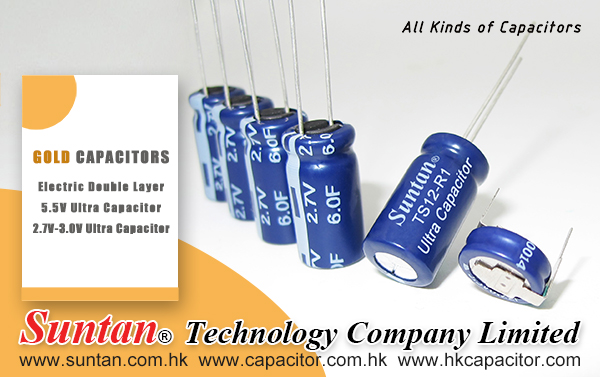
| TS12 (Standard) | Radial Gold Capacitor | 5.5 V / 6.3 V | IoT node hold-up, MCU/RAM backup, brownout protection |
| TS12-01 (Coin Type) | Slim coin package | 5.5 V | Memory/RTC retention, compact meters and sensors |
| TS12-ML | Low-ESR emphasis | See datasheet | Fast charge/discharge, industrial controllers, UPS assist |
| TS12-MS | High-power handling | See datasheet | Transient smoothing, battery-assist, motor/relay events |
| TS12-R1 | Screw/Snap-in module | See datasheet | UPS/EV subsystems, renewable power buffering |
Note: Always select by the official datasheet for exact voltage, capacitance, ESR, ripple, and lifetime ratings.
Design Benefits for Embedded and Industrial Systems
Low ESR for fast transients: Reduces voltage droop during load steps and start-up surges, ensuring stable MCU and communication performance.
Maintenance-friendly: Unlike small lithium or coin batteries that require periodic replacement, the TS12 series operates for over 100,000 cycles with zero maintenance needs.
Temperature resilience: Designed to perform across –25°C to +70°C, ideal for smart meters, outdoor IoT sensors, and factory automation devices.
Compact energy buffer: Its small footprint and radial or coin-type form reduce board space compared to batteries with holders or protection circuits, making integration easier in high-density PCB layouts.
Typical Applications
| Application | TS12 Role | Outcome |
|---|---|---|
| Smart energy meters / AMI | Hold-up for MCU, RAM, RTC | Prevents data loss and resets during dips |
| IoT gateways & sensors | Bridges brownouts / load steps | Maintains handshake and uplink |
| Industrial PLC / control boards | Transient smoothing on 5–12 V rails | Stable logic state through switching events |
| UPS assistance / ride-through | Short-term energy buffer | Improves response without oversizing batteries |
See It in Action
Implementation Tips
Place close to the load: Position the supercapacitor as near as possible to the primary IC or power rail it supports. This minimizes loop inductance and ESR impact, ensuring fast energy response and stable voltage during transients.
Charge control as required: Follow datasheet recommendations for inrush current limiting or charge balancing circuits. Proper charge control extends component lifetime and prevents stress on upstream regulators.
Derate smartly: Always select voltage and temperature margins in line with the official Suntan TS12 datasheet. Operating at around 70–80% of rated voltage enhances reliability and extends service life.
Verify with transient profiles: Simulate real-world dips and surges using your system’s transient test data. Confirm the capacitor’s discharge time and recovery behavior meet your hold-up and stability requirements.
Next Step
Always refer to the official Suntan datasheets for detailed ratings, safety notes, and design limits. Specifications may change without prior notice.