



In switch-mode power supplies (SMPS), LED drivers, telecom DC rails, and industrial control modules, engineers often ask: “Should I use a fast recovery rectifier diode or a Schottky rectifier?” This FAQ explains the functional difference between fast recovery diodes (for example Suntan ES2J and RS3M) and Schottky barrier rectifiers (for example Suntan SS310 and SS510), and shows how forward voltage drop (VF), reverse recovery time (trr), reverse voltage rating (VRRM), surge capability (IFSM), and thermal resistance affect efficiency, heat, and long-term reliability.
All electrical and reliability data must follow the official datasheets. The examples below reference Suntan ES2J (Super Fast Recovery Rectifier), RS3M (Fast Switching Rectifier), SS310 and SS510 (Schottky Barrier Rectifiers in SMC package).
1. What is a Fast Recovery Rectifier Diode?
A fast recovery diode is a PN junction rectifier optimized for short reverse recovery time. When the diode switches from forward conduction to reverse blocking, the stored charge is removed quickly so the device can tolerate high-frequency switching without generating large reverse current spikes.
Suntan ES2J and RS3M belong to this category. They are designed for high-voltage rails and rectification stages where reverse standoff voltage is critical. Key behavior:
• High VRRM capability. ES2J specifies reverse voltage in the hundreds of volts class,
while RS3M specifies up to approximately 1000 V class, making them suitable for industrial and inverter environments.
• Controlled trr. Fast recovery diodes significantly reduce reverse recovery time
compared to general-purpose rectifiers, which helps limit EMI and switching loss in PFC stages,
motor drive feedback paths, and high-voltage DC rails.
• Rugged surge handling. Devices such as RS3M are built in DO-214AB (SMC) package,
supporting strong surge current capability and mechanical robustness.
In short: fast recovery rectifier diodes are used when you need high voltage withstand and controlled recovery behavior on medium- to high-voltage power nodes.
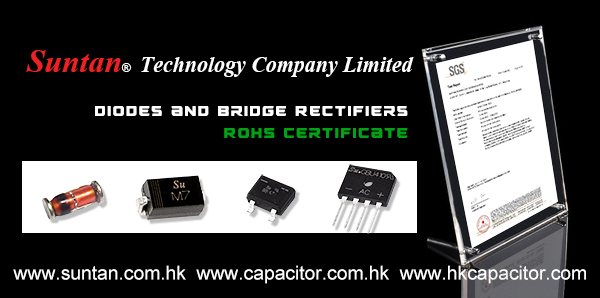
2. What is a Schottky Rectifier Diode?
A Schottky rectifier diode uses a metal–semiconductor junction instead of a traditional PN junction. Because there is almost no minority carrier charge to sweep out, a Schottky device shows extremely fast switching with negligible reverse recovery.
Suntan SS310 and SS510 are Schottky barrier rectifiers. Their main advantages:
• Low forward voltage (VF). Schottky parts typically run with a forward drop in the
~0.5–0.85 V class at rated current, versus ~1.2–1.3 V for many fast recovery parts.
Lower VF means lower conduction loss in the secondary side of an SMPS or DC/DC stage.
• Very fast switching. With virtually no reverse recovery charge,
Schottky diodes are ideal for high-frequency, low-voltage outputs such as
5 V / 12 V rails, LED driver outputs, and telecom supply rails.
• Thermal benefit in low-voltage rails.
Lower VF translates into lower diode temperature rise at the same load current,
which is important in compact enclosures.
Limitation: Schottky rectifiers usually have lower VRRM ratings (for example 100 V class) compared to fast recovery diodes, so they are normally not dropped into high-voltage PFC or inverter locations.
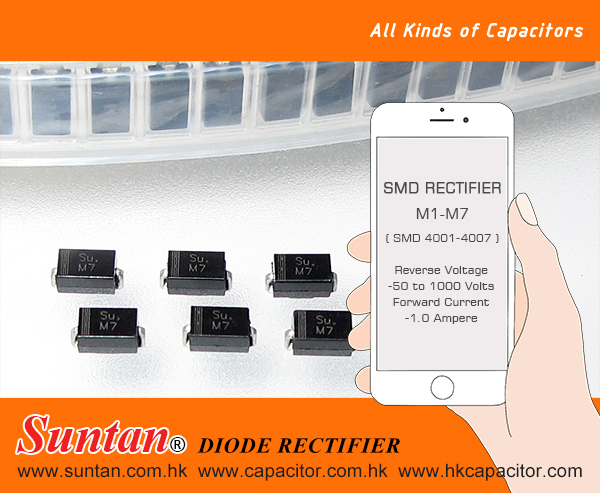
3. Fast Recovery vs. Schottky — Practical Selection Rule
A common selection rule used in rectifier diode choice is:
• Use a fast recovery diode (for example ES2J, RS3M)
when you are rectifying or clamping a higher-voltage node,
or when you need robust surge behavior in industrial / inverter / motor control paths.
• Use a Schottky rectifier (for example SS310, SS510)
in low-voltage, high-frequency outputs to cut forward loss
and improve efficiency in SMPS secondary rectification,
LED drivers, and telecom power modules.
In other words, fast recovery = higher voltage robustness. Schottky = lower power loss at lower voltage.
4. Technical Comparison of Key Suntan Rectifier Diodes
| Model | Type | Reverse Voltage (VRRM) | IF(AV) | Forward Voltage (VF) | Reverse Recovery (trr) | Surge (IFSM) | Package |
|---|---|---|---|---|---|---|---|
| ES2J | Super Fast Recovery Rectifier | High voltage class (hundreds of volts) | 2 A class | ~1.25 V typ. at rated current | Fast (tens of ns scale) | Strong surge capability | SMB / DO-214AA |
| RS3M | Fast Switching Rectifier | Up to ~1000 V class | 3 A class | ~1.30 V typ. at rated current | Fast recovery (hundreds of ns) | High surge, DO-214AB scale | SMC / DO-214AB |
| SS310 | Schottky Barrier Rectifier | Low voltage class (around 100 V) | 3 A class | Low VF (~0.5–0.85 V class) | No classic reverse recovery spike | High surge | SMC / DO-214AB |
| SS510 | Schottky Barrier Rectifier | Low voltage class (around 100 V) | 5 A class | Low VF (~0.5–0.85 V class) | No classic reverse recovery spike | Strong surge capability | SMC / DO-214AB |
Summary of table above: ES2J and RS3M are used on high-voltage rails and protection/rectification stages that demand high VRRM and managed recovery. SS310 and SS510 are optimized for high-efficiency, lower-voltage outputs where forward voltage drop dominates thermal budget.
5. Expert Insights: Common Questions from Power Design Engineers
Q1. Can I drop a Schottky rectifier in place of a fast recovery diode?
Not automatically. Schottky rectifiers such as SS310 and SS510 give you lower forward voltage and no reverse recovery spike, but they typically have lower reverse voltage capability. If the original position expects hundreds of volts reverse standoff, a 100 V class Schottky will not survive.
Q2. Why do people still use fast recovery diodes if Schottky is more efficient?
Because efficiency is not the only requirement. In PFC stages, motor drives, or industrial inverters, you may need 600 V – 1000 V reverse blocking plus surge endurance. Devices such as RS3M are designed specifically for that environment; a low-voltage Schottky cannot replace that role.
Q3. How does forward voltage (VF) impact thermal design?
VF translates directly into heat. Dropping VF from ~1.3 V (typical fast recovery conduction drop) to ~0.7 V (typical Schottky drop) can improve efficiency by a few percent on a low-voltage rail. That lower loss helps keep junction temperature within safe limits in compact SMPS modules, LED drivers in sealed housings, or telecom bricks.
Q4. Are these diodes suitable for automated SMD assembly?
Suntan ES2J, RS3M, SS310, and SS510 are supplied in SMB / SMC style surface-mount packages (DO-214AA / DO-214AB). They are qualified for reflow soldering and high-volume assembly, supporting mainstream SMPS, LED driver, and telecom production lines.
Fast Recovery vs Schottky Rectifiers in Power Electronics
Watch: How Suntan fast recovery diodes and Schottky rectifiers impact SMPS efficiency, switching behavior, and thermal performance.
Next Step
Suntan ES2J / RS3M fast recovery rectifier diodes and SS310 / SS510 Schottky rectifier diodes — designed for SMPS, LED drivers, telecom power rails, and industrial control modules.
References
- Suntan Rectifier Diode Series (ES2J / RS3M / SS310 / SS510) – official product specifications and datasheets.
- Industry application notes on fast recovery rectifiers in high-voltage PFC and inverter stages, and Schottky rectifiers in low-voltage SMPS secondary rails.