


High-Power Thermal Management with Conduction Cooled Capacitors: Suntan TS24 Series
Suntan Technology Company Limited
· High-Power Film Capacitor & Thermal Management Component Manufacturer
In modern medium- and high-frequency power electronics—such as induction heating systems, industrial RF generators, and high-power resonant converters—resonant tank circuits operate under continuous circulating currents reaching hundreds of amperes. Under these strenuous electrical conditions, traditional capacitors rapidly accumulate internal hotspot temperatures, leading to accelerated dielectric aging, capacitance drift, and destructive thermal breakdown. The Suntan® TS24 overcomes these thermal boundaries through low-loss polypropylene dielectrics, extended foil metallization, and direct conduction-cooled mechanical terminals.
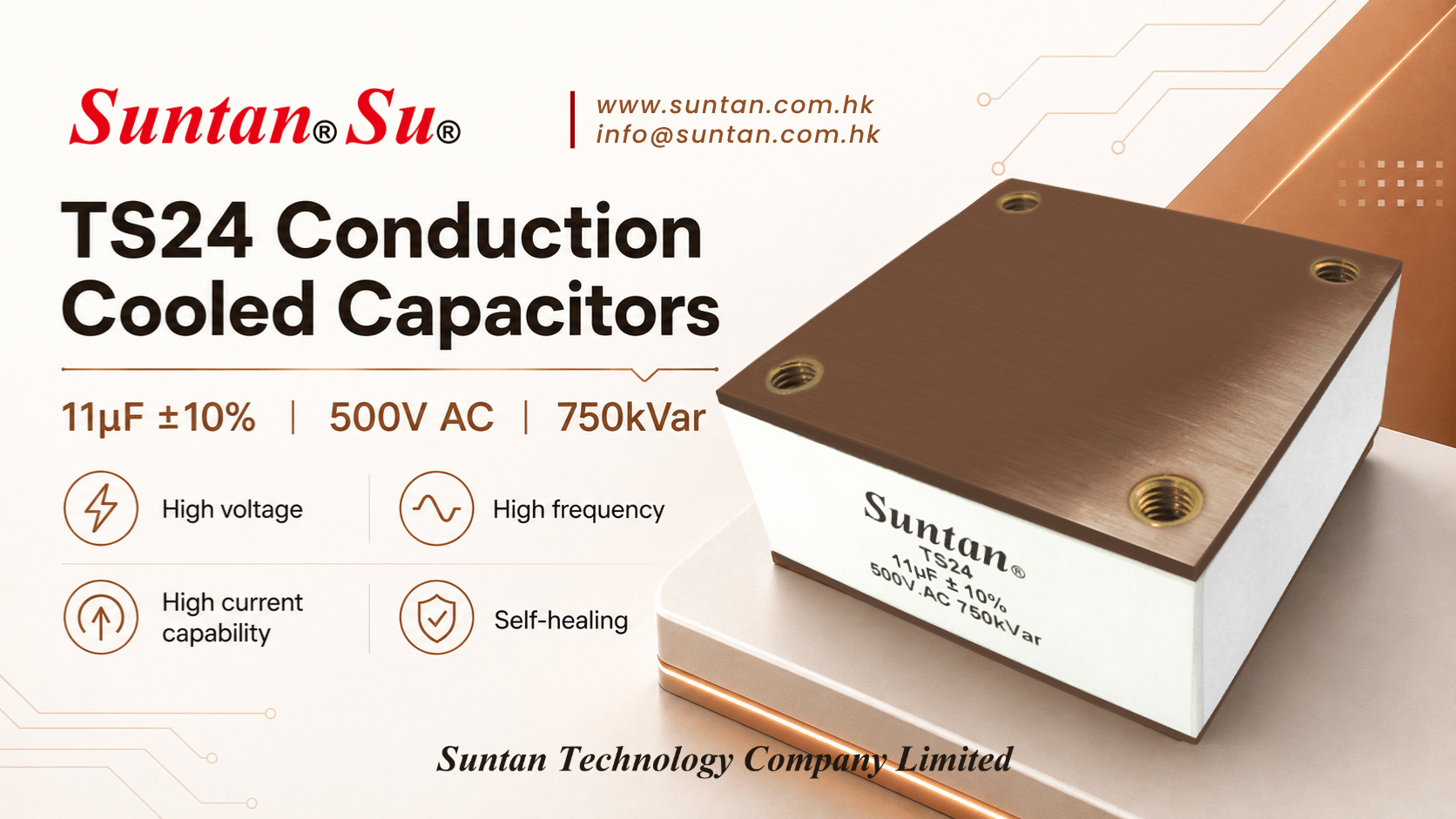
Figure 1: Suntan® TS24 conduction cooled capacitor featuring low-inductance busbar mounting surfaces for direct heatsink attachment.
Core Engineering Advantages of Suntan® TS24
Engineered to meet demanding thermal and electrical stresses, the TS24 series delivers multi-faceted architectural advantages across high-frequency power platforms:
Direct-Path Conduction Cooling via Mounting Surface
Eliminates reliance on airflow. Flat, precision-machined conduction plates bolt directly to water-cooled copper busbars or cold plates, achieving minimal thermal junction resistance (Rth) and preventing localized internal hotspot accumulation.
Exceptional dv/dt & Peak Current Handling
Incorporates specialized heavy-edge metallized film and robust non-inductive internal geometry, allowing TS24 to withstand severe voltage rise rates (dv/dt) and heavy repetitive peak currents without delamination or electrode wear.
Ultra-Low ESR & High Reactive Power (kVar)
Extremely low equivalent series resistance (ESR) dramatically minimizes Joule self-heating (P = I2 × ESR) during continuous high-frequency excitation, effortlessly accommodating reactive ratings of 300kVar, 600kVar, 750kVar, and up to 800kVar.
Suntan® TS24 Technical Specifications Matrix
Review primary operating parameters, voltage ratings, capacitance spans, and datasheet specifications for the TS24 series:
| Parameter | Engineering Value / Range | Operational Benefit |
|---|---|---|
| Series Name | TS24 Conduction Cooled Capacitor | Direct conduction thermal transfer |
| Rated Voltage (AC) | 400 VAC ~ 1,000 VAC | High-voltage resonant safety headroom |
| Capacitance Range | 0.1 μF ~ 84 μF | Broad tuning range for LC / tank circuits |
| Rated Reactive Capacity | 300 kVar, 600 kVar, 750 kVar, 800 kVar | High power density in compact volume |
| Operating Life Expectancy | Up to 200,000 hours (at rated conditions) | Long service life in continuous duty cycles |
| Dissipation Factor (tan δ) | ≤ 5 × 10⁻⁴ (1 kHz, 20°C) | Ultra-low dielectric loss & minimal self-heating |
| Datasheet Link | Suntan TS24 Product Datasheet | Full dimensional & electrical data |
Target Applications & Selection Checklist
Suntan® TS24 capacitors are engineered for heavy-duty industrial and power electronic topologies operating under intense high-frequency stress:
Conduction Cooled Capacitor Selection Checklist:
People Also Ask — Conduction Cooled Capacitor Engineering FAQ
A conduction cooled capacitor is an advanced high-power, high-frequency capacitor designed to dissipate internally generated thermal energy through direct solid-state contact with an external heatsink, cold plate, or conductive busbar, rather than relying on convective airflow. This structure enables extraordinarily high power density and reliable continuous operation in sealed power systems.
Explore Suntan TS24 Conduction Cooled Structure →You should specify a conduction cooled capacitor when power circuits encounter severe continuous RMS currents (hundreds of amperes), high operating frequencies (tens to hundreds of kHz), compact or hermetically sealed enclosures (such as IP65/IP67 equipment), or applications where convective air cooling cannot maintain junction temperatures within safe limits.
Conduction cooling establishes a direct, metallic thermal pathway with minimal thermal resistance from the internal dielectric winding to an external cooling plate or heatsink. This prevents localized hotspot buildup, limits thermal drift, safeguards dielectric integrity, and ensures consistent capacitance stability under continuous maximum load.
dv/dt specifies the maximum rate of voltage rise over time (expressed in V/μs). In high-frequency resonant circuits and fast-switching inverter bridges, rapid commutations create extreme dv/dt spikes. High dv/dt capability ensures that the capacitor withstands large repetitive peak currents (Ipeak = C × dv/dt) without internal arcing or terminal bond failure.
Equivalent Series Resistance (ESR) reflects the internal resistance of the dielectric and conductor terminations. Because power dissipation scales with the square of the RMS current (Ploss = IRMS2 × ESR), ultra-low ESR is critical in suppressing internal heat generation, preserving efficiency, and preventing destructive thermal runaway.
View Low ESR TS24 Performance Data →Yes. Conduction cooled capacitors represent the primary component in induction heating generators and melting systems. Connected directly in series or parallel with the work coil to form the resonant LC tank, they handle enormous circulating reactive powers (up to 800kVar+) while bolted to water-cooled cold plates.
Conduction cooled capacitors like the Suntan TS24 are purpose-built for resonant converter circuits (LLC, LCC, and tank configurations). Their tight capacitance tolerance, high Q factor, low dissipation factor, and extreme current capacity ensure precise resonant tuning and negligible loss under high-frequency operation.
Key applications include induction heating, induction melting furnaces, high-frequency resonant inverters, industrial welding equipment, high-power wireless electric vehicle (EV) charging stations, plasma generators, and medical RF power equipment.
Follow a five-step selection methodology: 1) Verify operating AC/DC voltage ratings; 2) Determine maximum continuous RMS current and switching frequency; 3) Confirm peak dv/dt tolerance; 4) Check required reactive power (kVar); 5) Review mounting interface flatness, thermal interface material (TIM), and busbar connection torque.
When operated strictly within designated voltage, current, and hotspot temperature ratings—supported by adequate heatsink thermal management—Suntan TS24 conduction cooled capacitors can achieve an expected service life of up to 200,000 hours at rated conditions. Exceeding rated operating temperatures or electrical thresholds will shorten service life accordingly.
Suntan® continues to support global power electronics and hardware design teams with robust, high-performance conduction cooled film capacitors. For custom mounting geometries, high-kVar requirements, or engineering samples, please contact our technical sales team.